House Majority Hinges on 46 Toss-up Districts and New Maps
With polls open on Election Day, the fight for the 218th seat turns on a three-seat margin, shifting voter maps in seven states, and a significant Republican spending advantage.
By Gabriela Ivanov ·
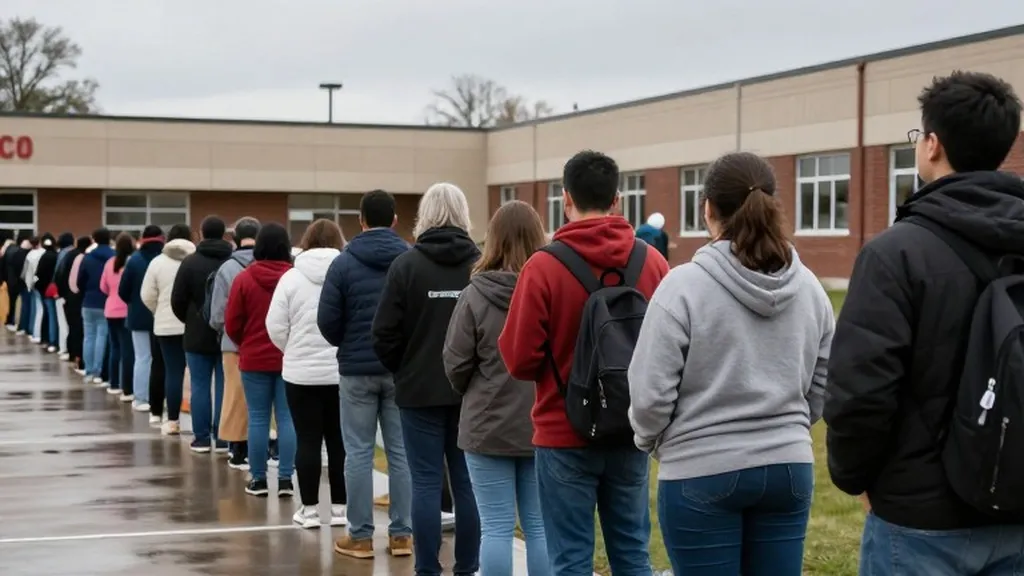
On this Election Day, November 3, 2026, voters are casting ballots to determine which party will control the U.S. House of Representatives for the final two years of President Donald Trump's second term. All 435 seats are up for election, creating a high-stakes contest for the chamber that has become the primary arena for oversight and legislation. The Associated Press describes the day as a referendum on the administration, with many voters citing high prices and an unpopular war with Iran as central factors in their decision.
The current composition of the House is extremely narrow. Republicans hold 218 seats, while Democrats hold 214, with one independent seat and some vacancies. This split means Democrats need a net gain of three districts to secure a majority. Conversely, Republicans can afford to lose no more than two seats to maintain control. This three-seat margin makes the outcome of the 46 battleground districts identified by Ballotpedia the deciding factor for the chamber.
Ballotpedia has classified 46 districts as battlegrounds, with 25 currently held by Democrats and 21 by Republicans. The geographic and political dynamics of these districts are complex. For instance, 21 districts currently held by Democrats voted for Trump in the 2024 presidential election. In contrast, nine districts held by Republicans voted for Kamala Harris. These splits suggest that the new congressional maps are not perfectly aligned with the presidential leanings of the voters in those areas.
A significant change in the electoral landscape comes from mid-decade redistricting. Six states are using new congressional maps in California, Florida, Missouri, North Carolina, Tennessee, and Texas. Ohio is also utilizing a new map for this election. The Associated Press notes that while Republicans attempted to use redistricting to beat the historical midterm pattern where a president's party loses seats, the new districts in Florida and other states may not vote as they were originally drawn.
Financial disparities are a major theme in this year's race. The 2026 elections are likely to be the most expensive in history. Republican committees have outraised and outspent Democratic committees at the committee level, aided significantly by Trump-affiliated groups and Elon Musk. However, at the candidate level, Democrats have outraised their opponents. An AP analysis of AdImpact data shows that 88.1% of Republican general election TV ad spending went to states and districts that Trump won in 2024. This includes more than $850 million spent in areas where his 2024 margin was 10 points or more.
Voter sentiment is heavily influenced by the cost of living and health care. AP-NORC polling indicates that only 35% of U.S. Adults approve of Trump's job performance, while 25% approve of his handling of the economy. About seven in ten adults say the country is heading in the wrong direction, and most blame the president for high prices. James Moore, a 57-year-old librarian in Raleigh, North Carolina, said that he is paying more in taxes, for health care, and for everything else. His comments reflect the broader frustration that Democratic leaders are trying to leverage in these tight races.
The race is also defined by the behavior of the incumbent party. Sixty House incumbents did not run again, with 37 Republicans and 23 Democrats retiring or stepping aside. This high turnover adds uncertainty to the outcome. Democrats are described as cautiously optimistic, while Republicans are bracing for the possibility of losing the House. The Associated Press notes that one or two seats could tip the balance of power in either chamber, making the final count critical.
In the House, the stakes extend beyond simple control. If Democrats win the majority, investigations and possible impeachment proceedings become likely. House Democratic Leader Hakeem Jeffries has outlined a 100-day agenda focused on the cost of living and oversight. A strong Democratic night would also boost potential 2028 candidates such as Gavin Newsom, JB Pritzker, and Pete Buttigieg. For Republicans, holding the House is essential to blocking Democratic initiatives and maintaining the legislative agenda of the administration.
As polls open across the country, the administrative machinery is working to ensure every ballot is counted. The U.S. Postal Service has added hours, staff, and special lines to ensure mail ballots are processed on time. A federal judge temporarily barred the Trump administration from carrying out a plan to prevent noncitizen voting, a move critics said risked disenfranchising eligible voters. In California, a judge ordered the administration to stop demanding that election officials segregate ballots cast by people on lists of suspected noncitizens.
The outcome of the House race will have immediate implications for the Senate and gubernatorial races. While the Senate and governorships are also in play, the House contest is viewed as the clearest measure of national sentiment on the economy and the administration's performance. With 57 million people having already voted as of Monday, surpassing early vote totals from four years ago in many states, the final outcome will depend on turnout in these 46 key districts. The new maps in seven states will test whether the redistricting efforts by Republicans have created a durable advantage or if the voters have shifted in the meantime.