West Bank barrier cuts off 3.4 million Palestinians as 925 obstacles restrict movement
OCHA data shows the separation wall and accompanying infrastructure have fragmented Palestinian access to land, work, and services since 2002.
By Gabriela Ivanov ·
Israel’s separation wall in the occupied West Bank restricts the movement of approximately 3.4 million Palestinians through a network of physical barriers and administrative controls. The structure, which began construction in 2002, now operates alongside a dense system of checkpoints and roadblocks that dictates daily life for residents across the territory.
The planned length of the barrier is 712 kilometers. By April of this year, the United Nations Office for the Coordination of Humanitarian Affairs (OCHA) reported that 456 kilometers of that route were completed. This represents 64 percent of the total planned distance. The barrier does not follow the 1949 armistice line, known as the Green Line. Instead, 85 percent of the built route extends deep into Palestinian territory, altering the geographic and social layout of the region.
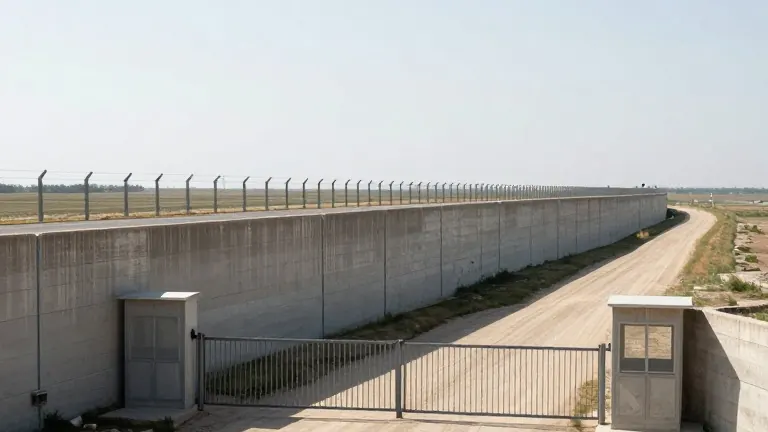
In urban centers, the physical barrier often takes the form of concrete rising to about 9 meters in height. In other areas, the structure consists of fences, patrol roads, ditches, and other security infrastructure. This physical division is part of a larger administrative framework. OCHA documented 925 distinct obstacles across the West Bank and occupied East Jerusalem as of December. These include 89 permanently staffed checkpoints, 218 partial checkpoints, 232 road gates, 167 earth mounds, 114 linear closures, and 105 roadblocks.
The composition of these obstacles has shifted over the past twenty years. Checkpoints and road gates now account for nearly 60 percent of the total network. Two decades ago, temporary blockages such as earth mounds and roadblocks made up 15 percent of the restrictions. This change indicates a move toward more permanent and structured control points for Palestinian movement.
The barrier’s route has created a specific area known as the Seam Zone, which lies between the wall and the Green Line. More than 14,000 Palestinians live in this zone. To reach basic services, markets, or relatives on the other side of the barrier, residents must pass through designated checkpoints. OCHA data indicates that about 150 Palestinian communities hold agricultural land in this area. Access to that land depends on permits and prior coordination with Israeli authorities.
Agricultural access remains a central issue for livelihoods. There are approximately 62 agricultural gates along the wall. Most of these gates remain closed for significant portions of the year. During the 2025 olive harvest, 74 percent of these gates opened only on a limited number of days. This irregular access complicates the harvesting season for farmers who rely on consistent entry to their fields.
The city of Qalqiliya exemplifies the barrier’s impact on urban connectivity. The wall wraps around much of the city, isolating it from nearby Palestinian communities and surrounding land. Trips to neighboring towns that were once short drives now require passing through checkpoints or taking long detours. This fragmentation reshapes how communities interact with their immediate environment and essential services.
Crossing the wall itself requires specific documentation. The barrier has 13 checkpoints, but only three are accessible to Palestinians holding West Bank IDs and Israeli-issued permits for entry into East Jerusalem and Israel. OCHA notes that these permits are difficult to obtain. Many permits have been revoked or suspended since October 2023, when the Hamas-led attacks on southern Israel and the subsequent war in Gaza began. The physical structure thus functions as a gatekeeper for both movement and legal status.
A Palestinian activist in Bir Nabala compared the barrier to the Berlin Wall, which fell on November 9, 1989. The activist stated, “It doesn’t matter how high the barriers will be, they will fall. Like the Berlin Wall fell, the Palestinian wall will fall.” Palestinians have marked this date as an international day of action against the barrier since 2003. The current barrier is more than four times the length of the Berlin Wall, which encircled West Berlin for 155 kilometers over 28 years.