Utah Spaceport Report Splits on Launch
An 18-member committee recommends moving forward with development at Delta or Green River, while industry experts argue the state should prioritize landing spacecraft over launching them.
By Gabriela Ivanov ·
The Spaceport Exploration Committee issued its final report last week, recommending that Utah lawmakers proceed with developing a space facility at either Delta or Green River. The 18-member panel, co-chaired by State Senator Ann Milner and UDOT Commissioner Carlo Braceras, concluded that both launch and reentry services are feasible in the state. The report identifies specific routes at both preferred locations that meet Federal Aviation Administration safety requirements.
The committee narrowed its focus from seven potential sites to these two finalists based on capital costs, environmental impacts, and economic potential. Delta, in Millard County, ranked highest for market demand and technical operations. It benefits from nearby military operating agreements, favorable flight safety analyses, and access to major highways and rail lines. Green River, in Emery County, led in capital and operating costs. Its advantages include a historic launch heritage and a usable restricted corridor for point-to-point testing.
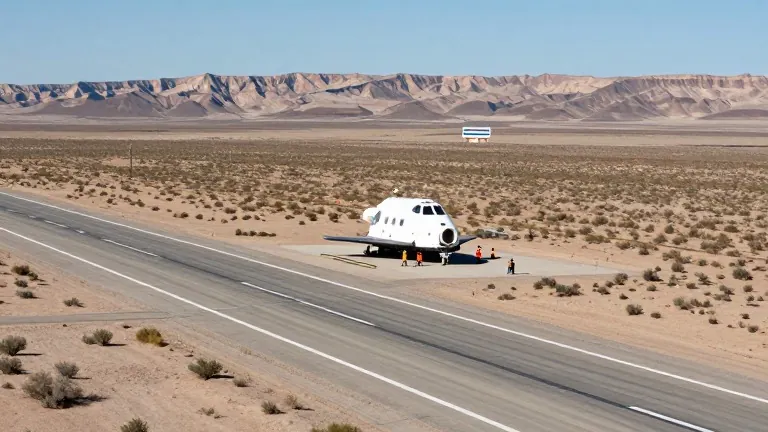
Despite the committee’s endorsement of a multimodal facility, critics argue that an inland launch site is impractical. Delian Asparouhov, co-founder and president of Varda Space Industries, testified before the committee last year. He stated that Utah is poorly positioned for commercial rocket launches but promising for landing vehicles returning from orbit. Asparouhov urged leaders to concentrate limited resources on reentry infrastructure to support in-orbit manufacturing, such as pharmaceutical processing.
Asparouhov noted that Varda returned its first manufacturing capsule to Utah’s Dugway Proving Ground in 2024. He described the process as difficult, leading the company to use a private landing range in Australia for subsequent missions. Nevertheless, he expressed a desire to return to Utah, citing its expansive landing areas. "I love Utah and I’d love for it to be Utah for reentry," he said.
Former NASA chief technologist A.C. Charania advised Utah to evaluate the spaceport based on realistic markets. He emphasized the need for a phased approach that builds on the state’s geography and aerospace expertise. Charania warned that industry growth does not automatically create an accessible market for a new launch site. He suggested tracking the 10 to 15 reentry companies currently operating internationally to identify demand for competitive landing locations.
Aaron Starks, president of the advocacy group 47G and a committee member, supports prioritizing reentry capabilities. He believes returning vehicles and materials from orbit offers a more affordable role for the state than duplicating coastal launch operations. Starks argued that while launch capacity would be a competitive advantage, Utah should focus on reentry to avoid competing directly with established facilities in Florida or California.
The committee’s four recommendations include securing site control, beginning FAA licensing and National Environmental Policy Act reviews, and authorizing the UDOT to lead development. The panel also reauthorized the Spaceport Exploration Committee to oversee these efforts. The report marks the first formal step toward realizing a vision that dates back to the 1970s, when Utah lost a national competition to host the Space Shuttle program.