Survivors face danger returning to el-Fasher
One year after the RSF took the city, civilians report assaults, arbitrary detention, and a persistent lack of security.
By Gabriela Ivanov ·
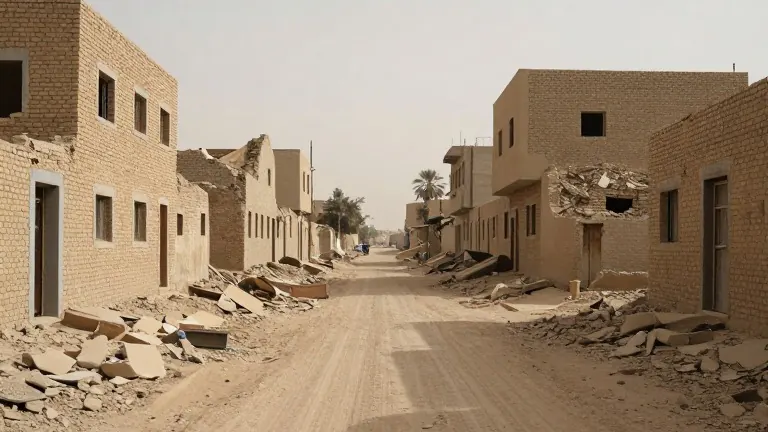
Hala, a Sudanese woman, returned to el-Fasher in early October after three weeks in a refugee camp in Tawila. She traveled in a vehicle operated by the Rapid Support Forces (RSF), the paramilitary group that captured the North Darfur capital a year ago. Upon arrival, she found houses looted or destroyed and streets altered by the occupation. RSF fighters intercepted her immediately upon her exit from the vehicle. They questioned her destination and the duration of her stay, suspecting deception.
Hala stated she needed to retrieve documents, including a birth certificate and ID, from a home without electricity. The fighters issued her a paper entry permit with her name, a signature, and the date. She described the RSF as difficult to deal with, noting that fighters could enter homes, threaten rape, beat residents, or imprison those who argued. She said that women face extreme danger in the city, while most visitors are fathers or elderly men because young people’s lives are at risk.
The day after her return, fighters in the street used abusive language toward Hala. They did not physically assault her because other civilians were present. She described the situation as strange, noting that fighters might assault a person and then claim the city belongs to them. She said there is no security in el-Fasher, with women facing sexual violence and those who refuse RSF demands facing torture. She returned to Tawila and said she will not go back, even if conditions improve.
The RSF launched its final offensive on el-Fasher on 26 October 2025 after a siege exceeding 500 days. Researchers at Yale's Humanitarian Research Lab described the speed and scale of the killing as comparable to the Rwandan genocide. Survivors reported that RSF fighters, backed by the United Arab Emirates, filmed mass killings, rapes, and executions. Mohamed Hassan, from el-Fasher, said fighters separated men from women and children, lashed the women, and fired randomly at the men. If a man was identified as a soldier from the Sudanese Armed Forces or Joint Forces, he was killed immediately.
Roughly 107,000 people fled the city six weeks before the assault, leaving about 260,000 inside when the offensive began. Doctors Without Borders asked where the remaining population went. Monitoring groups counted at least 6,000 dead in the first 72 hours using satellite imagery. The RSF has maintained a communications blackout, preventing human rights investigators from entering. A year later, bodies continue to surface. In Bara, North Kordofan, volunteers recovered more than 600 bodies from 200 mass graves this week.
In February, the UN Independent International Fact-Finding Mission determined the RSF committed acts of genocide in el-Fasher. The US government, the Raoul Wallenberg Centre for Human Rights, and Amnesty International have also determined the RSF committed genocide in Darfur. In July, Amnesty International called the atrocities a stain on the conscience of humanity. The RSF besieged the city from May 2024 to October 2025, building berms to trap civilians and cutting off food and medicine. The World Food Programme reported residents surviving on animal fodder and food waste.
A doctor who worked inside a hospital in el-Fasher for nearly two years said the hospital became the staff's entire world. Medical supplies ran out, and equipment broke down. Generators ran for only two hours at night, and emergency operations used mobile phone flashlights. Antibiotics and surgical gauze became unavailable. The doctor said pregnant women arrived in critical condition and premature babies depended on struggling equipment. Staff suffered malnutrition and injury while continuing to work. Yale's Humanitarian Research Lab identified 150 clusters of objects consistent with human remains between 26 October and 28 November 2025. Fifty-seven of these clusters disappeared within four weeks.