Male State claims responsibility for Italian flight bomb hoaxes
A Russian online group says it targeted Aer Lingus and Finnair jets, part of a wider wave of 25 threats across Europe.
By Gabriela Ivanov ·
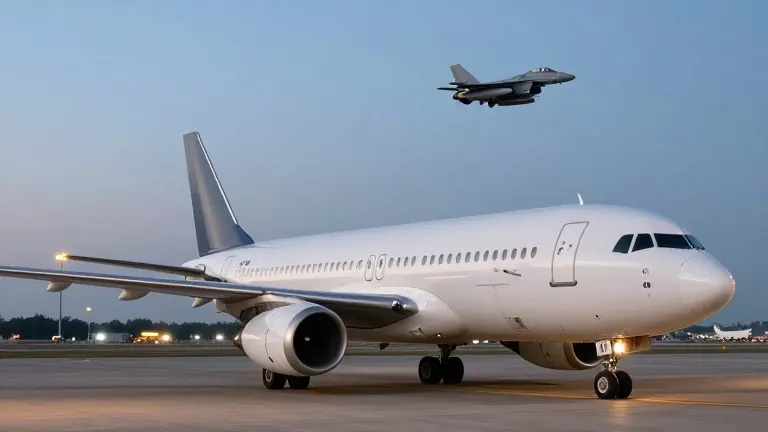
Two passenger flights heading to Italy were intercepted by military aircraft after a Russian extremist group claimed to have planted explosives on board. The disruptions occurred on Thursday as part of a coordinated series of threats affecting airlines across the continent.
The group, known as the Male State, identified itself in an email sent to Rome Fiumicino Airport. The message, titled 'reporting a threat,' named two specific flights: Aer Lingus EI402 departing from Dublin and Finnair AY1761 departing from Helsinki. The email warned that an explosion would occur within 60 minutes of the message being sent.
The Male State is a far-right organization that promotes patriarchy and Russian nationalism. Although the group was banned in Russia in 2021, it continues to operate primarily through online platforms. The email sent to Italian authorities stated, 'You are all complicit in a criminal conspiracy. We want to destroy you for this.' It concluded with the line, 'Your sky will be red today.'
French Prime Minister Sebastien Lecornu’s office confirmed that the Aer Lingus flight was diverted safely to Evreux airbase, located about 100 kilometers outside of Paris. Meanwhile, the Italian air force escorted the Finnair flight to Rome, where it completed its scheduled landing. A source close to the matter verified the escort operation.
The threats to the two Italian-bound flights were part of a larger pattern of activity. At least 25 other hoax bomb threats were reported across Europe on Thursday. These incidents affected routes from Ireland to Bulgaria and marked the second such wave in one week. Some aircraft made unplanned landings, while others were intercepted by fighter jets or escorted to the ground.
No European government has officially attributed the series of attacks to a specific country. However, many officials have accused Russia of orchestrating these actions as part of a hybrid attack strategy. These tactics are designed to be inexpensive and easily denied, avoiding a formal armed response. Denmark, Poland, and Romania have previously pointed directly to Moscow. Germany blamed Russia for an incident at Leipzig airport in August, while Britain has linked Iran to a suspected plot against a US air base. Both Russia and Iran have denied involvement in these specific aviation disruptions.
Eric Schouten, head of the aviation security group Dyami, noted that most affected countries support Ukraine in its war against Russia. He described the situation as hybrid warfare, stating, 'you always have to think about the scenario of hybrid warfare, where a country, in this way, today we are looking at Russia, right?, is attacking us on multiple fronts.' He listed railways, supermarkets, blood banks, energy, and the internet as previous targets, with aviation being the current focus.
Disruptions varied by region. In Bulgaria, fighter jets escorted three airliners to the ground. Ryanair flights from Copenhagen and Madrid landed in Sofia as planned, while a London-bound flight was diverted to Plovdiv. In Spain, authorities received three email threats within 20 minutes involving Air Europa and Iberia flights. Passengers disembarked in Madrid while planes were inspected. In Warsaw, a LOT flight to Paris was halted during taxiing, and passengers were moved to a different aircraft. A flight from Cork, Ireland, was delayed by 90 minutes.
Further checks were conducted at Copenhagen airport in Denmark, where police searched two planes. Italian media reported that a Wizz Air flight from Milan to Warsaw was diverted to Vienna. Several other flights landed on schedule after receiving threats, including Easyjet services from Britain, a flight from Ireland, and a flight from Greece arriving in Prague. Additional safe landings were recorded in Vienna, Brussels, and Bucharest for Finnair, LOT, Wizz Air, and Air Serbia aircraft.