Kipnuk Residents Wait for Homes as Repair Funds Fall Short
A year after Typhoon Halong displaced over a thousand people, FEMA money covers basic repairs but not relocation or severe structural damage in the remote Alaska village.
By Gabriela Ivanov ·
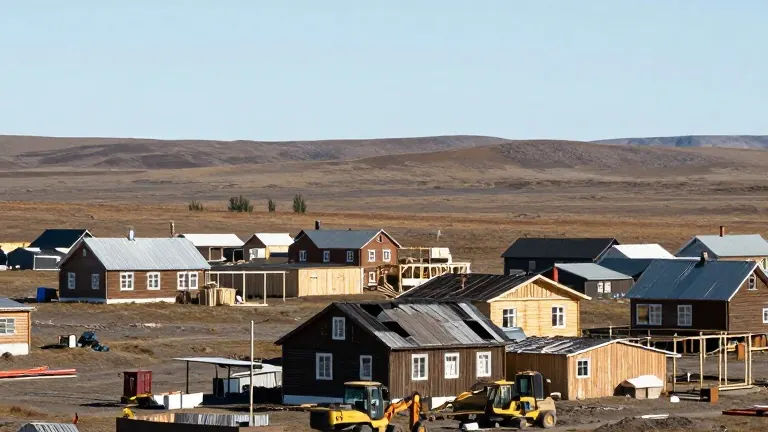
Hundreds of residents in the remote Alaska village of Kipnuk remain displaced one year after the remnants of Typhoon Halong struck the community. The storm destroyed infrastructure and floated homes off their foundations, leaving the village largely scattered across the state. While crews continue slow repair work on the open tundra, uncertainty persists regarding when families can return to their permanent housing.
State emergency officials report that 90% of the under 200 homes in Kipnuk were damaged last fall. Dozens of structures were swept from their foundations, some while families were still inside. The population has since been divided, with many residents living outside the region where their ancestors have lived for thousands of years. The village is only consistently accessible by plane, complicating the logistics of reconstruction.
Construction efforts have focused on making the existing structures livable. In August, Eddie Chuckwuk led a crew in using air compressors to raise buildings back onto their foundations. Chuckwuk, who grew up in the area, stated that the goal is to get people back so they can enjoy the place where they grew up rather than being placed in unfamiliar locations. He described the process of rebuilding as difficult but necessary to restore the community.
Funding constraints limit the scope of current repairs. According to the state, most residents lacked home or flood insurance. FEMA funds are expected to cover basic repairs such as replacing wet insulation and fixing windows, doors, and roofs by Thanksgiving. However, these funds are insufficient to return severely damaged homes to their pre-storm condition. The state is currently appealing for additional money to build replacement housing, while the local school remains open with no estimated reopening date.
Residents face cultural and practical challenges while living in larger towns like Anchorage. Many report speaking less Yugtun, the native language, and feeling farther from loved ones. Children who previously played freely across the village must now navigate traffic in urban settings. Leona Paul, a cook for the construction teams, noted that the trauma of the storm prevents some older residents from returning, even if their houses are habitable. She described the experience as overwhelming for many.
Climate change has increased the vulnerability of coastal villages like Kipnuk to future storms. Most residents want to rebuild the village in a safer location, but current FEMA funding can only be used to restore what was damaged. Kipnuk has not yet secured the money needed to move the community. This gap between the desire for relocation and the availability of funds leaves the village in a state of prolonged uncertainty.
Subsistence activities, such as hunting and gathering, have been disrupted by the displacement. Burt Paul’s family traveled home for the summer to practice these traditional food sources. On a tundra bluff upriver from Kipnuk, they harvested salmonberries, known locally as naunraqs. Paul, who stayed behind to lead community efforts during the aftermath, said seeing native plants growing and fish arriving was a relief after the destruction. His family’s summer trips were shorter than usual, confined to periods when everyone was present in town.
Paul emphasized the importance of continuing these traditions despite the circumstances. He stated that the community must keep things going in some way, no matter the situation. While his family and the wider village remain split, the work to stabilize the homes and preserve cultural ties continues without a set timeline for full reunification.