Janitzio Bars Tourists From Cemetery After Crowd Damage; Mexico City Parade Draws Doubts
Authorities on the Michoacan island closed the graveyard to visitors after tombs, crosses and a perimeter wall collapsed under the weight of holiday crowds.
By Giulia Donovan ·
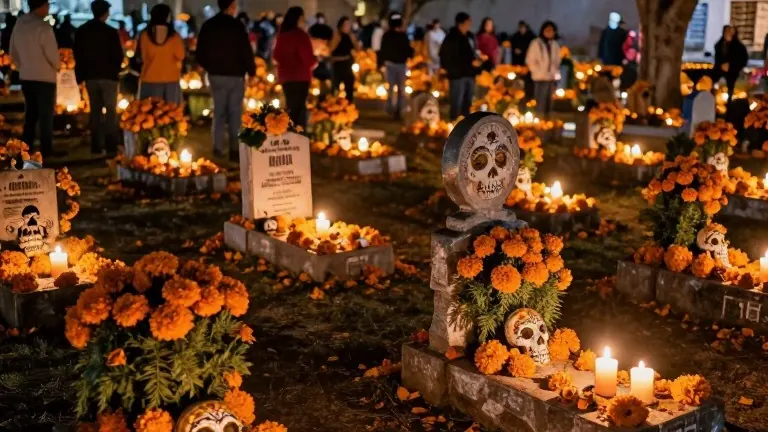
Tourist pressure is colliding with one of Mexico's oldest observances. On Janitzio, a small island in a lake in Michoacan, the community council reported that tombs, crosses and parts of the cemetery's perimeter wall gave way under the number of visitors. Authorities closed the burial ground to tourists for the first time this year; access is limited to friends and relatives of the people buried there.
The closure was announced during the annual Day of the Dead observance, which UNESCO recognized in 2008 as Intangible Cultural Heritage of Humanity for Janitzio. Festivities begin in October and run through November 1 and 2, when families believe the souls of the deceased return to earth to reunite with relatives. The date of the first commemoration is unknown, but the observance draws on pre-Hispanic agricultural beliefs; Catholic customs joined the celebration after the Spanish conquest of 1521.
Across the country, families build home altars and place sweets, food and mezcal beside photographs of the dead. Bakeries display pan de muerto, and streets, shops and markets fill with orange cempasúchil blooms, whose colors are said to light the path of returning souls. On the night of November 1, families gather in cemeteries, a practice their ancestors have kept for centuries.
In Mexico City, giant parades of floats carrying catrinas now move down the main avenue. The procession was created for the 2015 James Bond film Spectre and later folded into the city's festivities, though it was never part of the tradition. Many residents view the parade with skepticism. Celebrations in Oaxaca and Michoacan have drawn additional tourists, and some regions report tensions tied to heavy visitor traffic.
The city parade and the Janitzio closures fall on the same dates this year, November 1 and 2, when families across Mexico are scheduled to gather in cemeteries overnight.