AI in the Classroom: A Professor's New Rules for Data Science
Claudia Goldman requires Hebrew University students to document AI usage and prove human logic, banning fully automated answers in her data science courses.
By Gabriela Ivanov ·
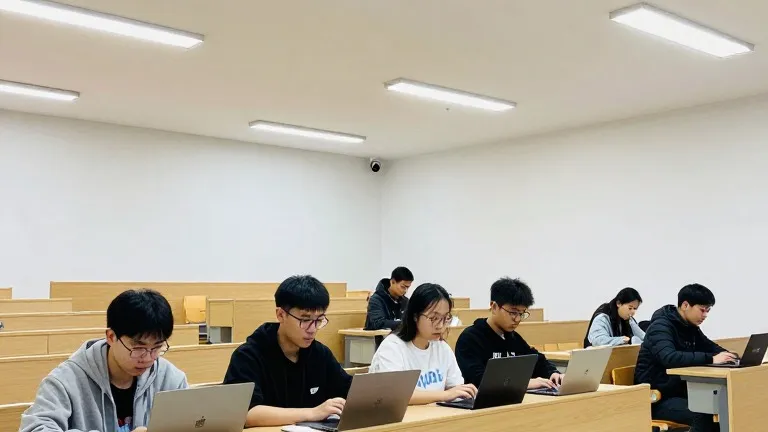
A new approach to artificial intelligence is reshaping how data science is taught in Jerusalem.
Claudia V. Goldman, an associate professor in the Data Science Department at the Hebrew University Business School, has established specific protocols for student use of AI tools. She has held the position since July 2024. Her method distinguishes between using AI as a brainstorming aid and submitting work that is entirely generated by the technology.
Goldman states that fully AI-generated answers are not accepted in her classes. She informs students that they can detect AI in writing and requires them to credit the technology used. Students must explain how they utilized the tools. The goal is to keep learners critical while they interact with the software. Goldman suggests checking for bias in the output. She also advises verifying that cited sources actually exist.
The assessment process relies on in-person interaction rather than just written submissions. Goldman evaluates students through classwork, presentations, and peer-organized activities. These formats allow her to observe understanding directly. The curriculum also includes discussions on human responsibility and professional values. The course examines what kind of researcher or person students should aim to be.
Goldman’s background informs her technical perspective. She holds 24 patents and has published more than 50 academic papers. Before joining the Hebrew University, she worked in the private sector for over a decade. She served as a team leader at Samsung Telecom Research in Herzliya. She later spent 15 years as a research scientist at General Motors’ research and development organization in the same city. At General Motors, she focused on learning agents for vehicle user experiences to help drivers understand autonomous driving functions.
Her academic path began in Argentina, where she was born. She moved to Israel with her family in January 1984 at the age of 16. She graduated from Mae Boyer High School in Jerusalem in 1986. She then earned a BSc in computer science, mathematics, and electronics in 1991. She completed an MSc in computer science in 1993 and a PhD in computer science in 1999. Her doctoral supervisor was Jeff Rosenschein. Between 1999 and 2005, she held research posts at Bar-Ilan University, the University of Massachusetts Amherst, and the University of Haifa.
Regarding the role of AI in the workforce, Goldman offers a nuanced view. She responded to Bill Gates’s suggestion of a 'Human Reserved' concept, which proposes setting aside specific jobs for people. Goldman argues the issue is not a simple binary choice of which professions remain human. She believes it requires understanding the benefits AI brings to different contexts. It also requires identifying the critical skills needed to strengthen those roles.
The Hebrew University Business School offers related courses, including AI for Social Good and Responsible AI. Another course is titled When AI Meets Humans and Society. The university also runs a Free Listener Program that allows senior citizens to audit classes. The fall semester is currently underway.
Goldman’s personal history includes a strong connection to the Hebrew University campus. She met her husband, Roy Shenhar, a full professor at the Hebrew University’s Institute of Chemistry, on the stairs of the Ross Building. They ran into each other three times in 1995. Following a Hebrew custom regarding unexpected repeated meetings, he bought her ice cream. They married in 1999.
Goldman’s family history also shaped her path. Her grandparents moved to Argentina before relatives were murdered in the Holocaust. Her parents were born in Argentina, and she was their only child. She attended a Jewish school in Buenos Aires through seventh grade, studying in Yiddish, Hebrew, and Spanish. In 1983, she told her father that she could only see herself growing up in Israel. Her family made aliyah six months later.